

Introduction
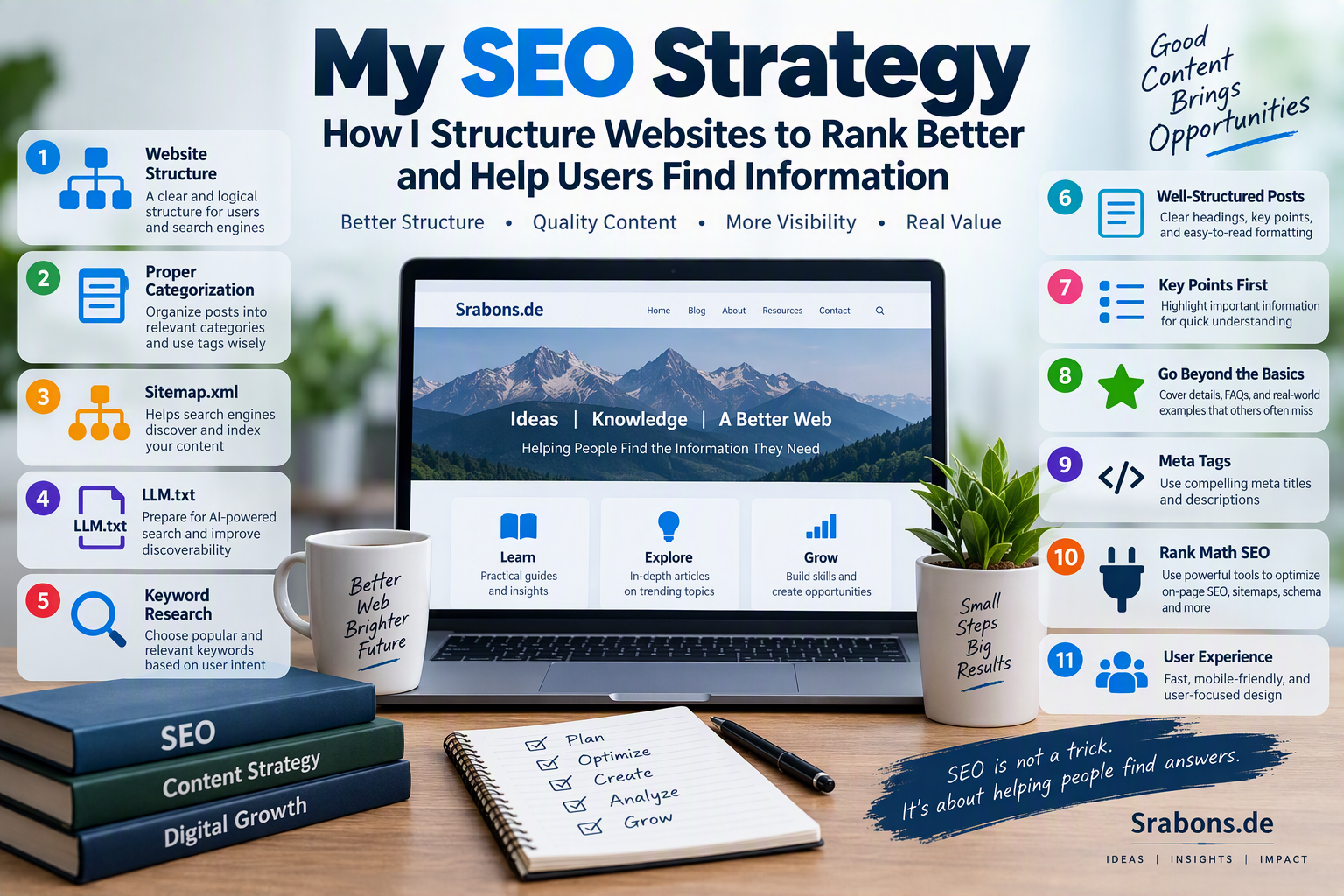
Search Engine Optimization is one of core thing someone needs for his website, or blog to be more recognized and visible to search engines. At this point with the advancement of AI, SEO leaps towards one more step ahead. People are not just competing for the visibility in search engines but AI based engines and sources of information for AI tools like Open AI , Microsoft Co-pilot, Gemini, Perplexity AI and so on and on. Besides, Search engines are nowadays more integrated with AI, where information are easily viable to search engines user.
So, bloggers and website builders need to do some extra works for search engine optimization. Here are the strategies I use for SEO (search engine optimization)
1. Structuring & Categorizing :
Structuring the website in a proper manner is the first & foremost things someone can do to make the blog or website visible to any AI based or non AI based search engine. So how to structure the website or your blog?
Let’s say I have my domain, Srabons.de
Under this, the Home is the main page where I can direct all my other pages. And for example, I have three pages like main page and then books, services, & about me. Now the structure becomes like
Srabons.de/books
Srabons.de/services
srabons.de/aboutme
Notes: No long words than this, proper structure and indexing.
then comes the categorizing,
for instance, books has sub domains, pages or sub genres like, biography, fiction and non-fiction. and it must come after
Srabons.de/books/biography
Srabons.de/books/fiction
Srabons.de/books/nonfiction
Note: Why is it important?
SO that the search engine can crawl through direction wise and find out information correctly.
That’s why structuring & categorizing is important.
Same goes for my posts as well. I categorize my posts properly so that the search engine properly & I use proper structure and table format so that the date can be easily crawled.
2. XML Sitemap
XML site map file helps to create a roadmap for search engines. it helps search engine discover new content faster and improves crawl effenciency. That’s why it is important to update the XML sitemap on a regular basis and submit it on Google search console.
3. Implenting llm.txt
Implenting llm.txt helps the AI based bots or search engines find your contnent and information effeciently and recognizes your information as valid to share with the search engine user. This helps better content discovery, improved understanding of site content & clear guidance for future AI crawlers.
4. Combining popular keywords with important keywords of my content:
I always combine the popular keywords in order to be easily found by the search engines or by the users. Besides, I identify common search phrases, user questions, search intents, targe long tail keywords, include natural keywords. & then I highlight the keypoints of my post so that it place important information rightly.
5. Covering details & questions that other often ignores
This is the best strategy if you are a new blogger & I never miss to surprise the users with new information that others miss or barely use.
6. Writing effective Meta Titles and Meta Descriptions
Meta tags remain an important of SEO. it must be clear and descriptive, include primary keywords & stay concise.
7. Using SEO plugins like Rank Math Seo
For my WordPress website, I prefer to use Rank Math Seo. its a good plug in especially for the beginners. Features it provides are
On-page SEO analysis, XML sitemap generation, Schema Markup, Meta tag optimization, Content scoring & Search Console integration.
8. Structuring Every Post for Search Engines and Readers
Good SEO content should be easy to read.
My content structure usually includes:
Introduction
Explains the topic and why it matters.
Main Sections (H2)
Covers major topics.
Subsections (H3)
Breaks down complex ideas.
Bullet Points
Improves readability.
Conclusion
Summarizes key takeaways.
This structure helps both readers and search engines understand the content more effectively.
9. Focusing on User Experience
SEO is no longer only about keywords.
Search engines increasingly reward websites that provide a positive user experience.
Areas I Prioritize:
- Fast loading speeds.
- Mobile responsiveness.
- Secure HTTPS connections.
- Easy navigation.
- Readable formatting.
A satisfied visitor is more likely to stay, engage, and return.
So, these are the strategies I follow for SEO. I hope this helps. Have a nice day.
Leave a Reply