Tag: culture

  • Pohela Boishakh

    What’s a cultural tradition from your country that you love?

    Hi everyone, good morning from Germany and I hope you are doing well. I’m also doing great. Today I’m going to talk about a cultural tradition from my country that I love. Let’s deep dive into it.
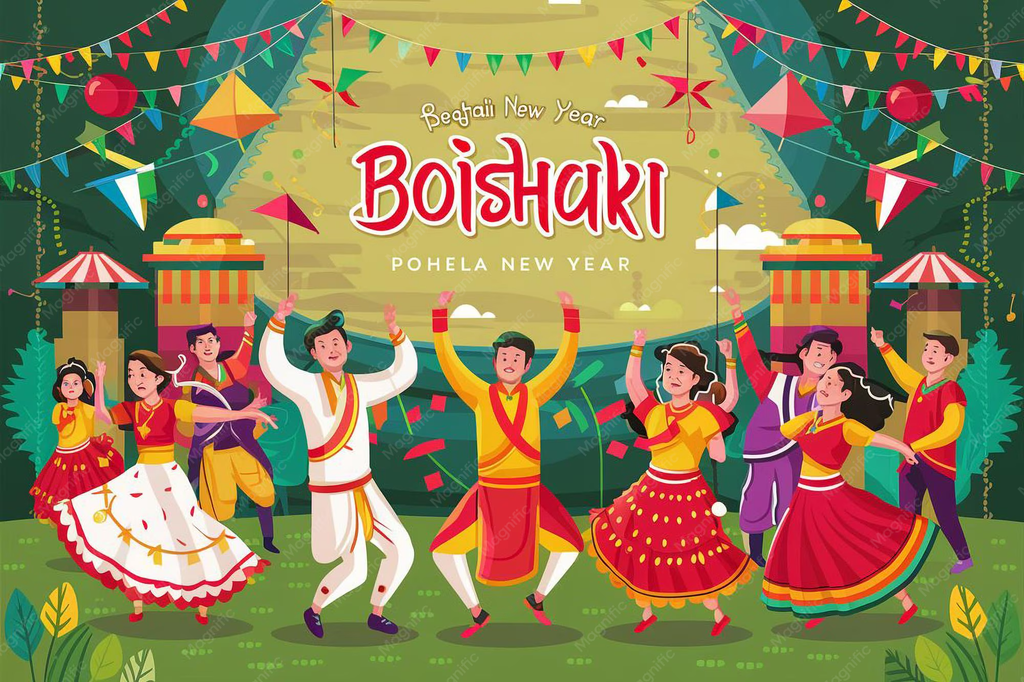
    Image Source: Bing search

    I am a Bengali from Bangladesh with a Hindu farmers background. My grandfather was a farmer and that’s why we follow the culture of peasants in Bangladesh. However, we also celebrate the Bengali traditions. Interestingly in both traditions for Pohela Boishakh is celebrated, although a bit differently. Interestingly, it is celebrated all over Bangladesh.

    So, let me introduce you to Pohela Boishakh. It is the first day of first Bengali month of Bengali year. People all over Bangladesh and Kolkata celebrate this day. And it is also celebrated in other cultures like in other parts of India and in Nepal but in different forms. As we follow our own calendar and own years, we just celebrate it different dates. For instance, you may find out in Bangladesh that people are celebrating this day on 14th of April. On the other hand the Hindu Bengalis celebrate it on 15th of April. The same goes for the Nepalese and Indians.

    Image source: Bing search

    If you look at the mainstream Bengali television, you would find out that the secular Bengali people celebrate the Pohela Boishakh. They make rallies with festoons and cartoons and call it Mongol Shovajatra. The boys wear Punjabi and Pajama and girls and women wear Sarees. Most of the dresses are colorful in order to celebrate the day with beauty. They also sing “Esho hein Boishakh” and invites Boishakh so that it may bring good to our cultures and our people . They also celebrate the day with Panta (watery rice) and Elish (Hilsha fish). It is said that the tradition is followed for years after years. There’s also Rabindra Sangeet organized at Ramna Batamul in order to purification and welcoming a fresh start.You also may find out Boishakhi Melas around the villages in Bangladesh along with Jatra, Baul Songs, Puppet show, and Nagordola. In urban areas, there is concerts, street food festivals, University campus events, art exhibitions and photography works organized.

    However, you look at the traditions of Hindu Bengali farmers, we celebrate it in a different way. For instance, we see it as a good day to begin our years and we believe that if we do something good and eat something good in this day, the possibility is higher that we would follow the same for the rest of the days of the year. That’s why we wear new dresses. we also worship to God so that He may bring good to the family. We, then eat something sweet like different types of Chatu, sweets and yogurts. Some people also like Doi Chira in this day. And then in the lunch, we eat vegetarian food. We expect the day would bring something good to the peasant families. During this time, the businessman starts their new notebook and celebrate it through what they halkhata.

    So, as you can see in the description that it is not just traditional thing but also a deeply culturally rooted celebration and almost every religion, caste and creed follows it. And that’s why it is always my favorite.

    Thank you very much. I hope you liked my post. Feel free to subscribe it if you like it. I wish you a pleasant day!!

    Follow Srabons.de Subscribe via Email Follow Me on Facebook

  • What is culture?

    My professor asked me one question in Thesis defense, and that is, “What is culture to you?”
    And I answered, “Culture is something where we can relate ourselves to, irrespective individual or collective. Where we can’t relate ourselves, there’s barely any culture there.”

    The man from this picture named Sonst, once met me in the forest, while I was meditating. He sat by my side and had an interesting conversation about different topics. The conversation was definitely quite intense, cause, we both were quite philosophical in nature. All on a sudden, he asked, “Are you left handed?”
    I said, “yes, why?”
    He said, “me too. Do you know? We are a minority of 10% in number. I had also some left handed girlfriends.”

    Sarcastically, I asked, “how many is actually ‘some girlfriends’ to you?”

    He said, “well, let’s not open the secret. Let’s say, I were quite lucky. “


    The fact is, Sonst was not wrong about the left landed people. Yet I was relating to him as a Bangladeshi, speaking to a German guy. He was not wrong at all too. Even if I was at his place, I wouldn’t also reveal the number of ‘some’ to others.

    #SDfolio
    #Srabonsmigratorydays
    #SDphotography
    #Sdstories
    #SDcreativeideas

  • Cultural Heritage

    Hercules, Kassel

    Brainstorming Heritage

    India is a country of many cultural livings. Almost all the states are different to each other. India is very known for its diversity. It is also known as a federal union. There is a saying in our Bengali culture, that India has all the seasons and views of the world whether it’s a sand desert (Rajasthan) or an ice desert (Ladakh). Indian civilization is one of the oldest civilizations in the world which is still the day alive. The Vedic culture of Hindus is yet alive and well practised. Interestingly, it has the most unique practising religion in the world which is called Hinduism. it is a cultural phenomenon that rose with its civilization specifically called the Indus civilization. The very interesting fact about the Hindu people is that the Hindu identity is not related to its religion but to its land. Yet Hindu identity is judged as a religious identity. Hindus gave birth to many great philosophies including Sanatana Dharma, Buddhism, Jainism and so on. With these ideologies, there also resides Muslim and Christian people with harmony and piece.

    Durga Puja, biggest Hindu festival in Bengal

    India has several heritage sites. According to Wikipedia, there are 40 World Heritage Sites located in India and out of these, the primary sites to be visited are the Ajanta Caves, Ellora Caves, Agra Fort, and Taj Mahal, all of which were inscribed in the 1983 session of the World Heritage Committee (‘List of World Heritage Sites in India’). Also, there are thousands of Hindu temples which are also a part of not just Indian culture but also of Heritage.

    In my opinion, Heritage is part of a culture which is something remarkable to that culture and shared from generation to generation. Heritage may vary in huge aspects. In a general outline, heritage is something that defines the past of a country or a culture.

    UNESCO and world heritage

    This image has an empty alt attribute; its file name is image-10.png
    Brandenburger Tor, Berlin

    So, to add furthermore about Heritage, heritage can not just be defined as a part of the culture, but it also becomes a part of someone’s identity too. Again, UNESCO defines world heritage as “the designation for places on Earth that are of outstanding universal value,” and defines culture as a set of distinctive spiritual, material, intellectual, and emotional features of a society or a social group (What Is Cultural Heritage?).  According to the UNESCO world heritage website, there are 1157 heritage property sites (Centre).  All those places do not just have a cultural value or an identical value but overall create a global value for which UNESCO declared them as a world heritage site rather than simply declaring it a cultural heritage. Once again, UNESCO has a very broader perspective on defining a culture. Therefore, the idea of heritage is also broadened through the definition of heritage.

    A little heritage theory

    Heritage creates something brand new in the here and now that draws from the past. Pieces of history are yours to find” (Kirshenblatt-Gimblett 370), implying that heritage already exists before it is discovered, evaluated, conserved, and celebrated. It’s a way of creating art right now that draws inspiration from the past (370). Heritage increases the worth of something already in existence. When an asset’s history is considered, it’s value increases even if it’s no longer operational (371). It’s not something that the economy cares about. As a means of “exporting” their product, heritage businesses rely on international visitors (373). Having a connection to one’s past helps one feel at home (373). As with tourism in general, heritage productions highlight the objects’ alienness from their display environments (374). Tradition and tourism both benefit from heritage’s ability to preserve and present them (374).

    Tradition and folklore: similarities and distinctions

    Kirshenblatt-Gimblett contrasts heritage with folklore by pointing out that both involve the passing on of cultural knowledge and meaning from one generation to the next, but that heritage is typically associated with institutionalized and formalized practices of cultural preservation and presentation. Conversely, folklore is typically considered a more casual and bottom-up form of cultural expression.

    Works Cited

    Centre, UNESCO World Heritage. ‘UNESCO World Heritage Centre – World Heritage List’. UNESCO World Heritage Centre, https://whc.unesco.org/en/list/. Accessed 18 Mar. 2023.

    Kirshenblatt-Gimblett, Barbara. ‘Theorizing Heritage’. Ethnomusicology, vol. 39, no. 3, 1995, pp. 367–80.

    ‘List of World Heritage Sites in India’. Wikipedia, 14 Mar. 2023. Wikipedia, https://en.wikipedia.org/w/index.php?title=List_of_World_Heritage_Sites_in_India&oldid=1144625820.

    What Is Cultural Heritage? https://projects.iq.harvard.edu/whoseculture/what-world-heritage. Accessed 18 Mar. 2023.